PURPOSE - 15 MIN READ
The Future of Purpose
The central psychological challenge of the future.
Ian Boreham - 10 Jul 2026
Purpose has always been a psychological system shaped by identity, agency, contribution, and meaning. But for the first time in history, the world is changing faster than the system can adapt. In this essay we look at the forces that are driving up the importance of purpose in modern life. The argument is that these forces are changing purpose from a nice to have, to ‘no longer optional’. The world is changing in ways that destabilize identity, continuity, and meaning. Unless we respond, both individually, and collectively, with a prioritization towards purpose, many will feel the negative effects. Let us start by defining purpose.
Purpose Defined
Academic definitions of purpose usually talk about ‘sense of purpose’ (the perceived feeling that one’s life has purpose) and ‘purpose in life’ (the more tangible aim towards which one is heading). Regardless, purpose (as we shall refer to it throughout) is often defined as having a central, self-organizing life aim or a coherent direction and set of goals.¹⁻³ My personal definition after years of research on purpose in life is as follows:
“Purpose is a coherent direction that extends at least 18 months into the future and organizes how a person engages with the world. It often stimulates goals and long‑term plans, but it doesn’t require them. Purpose is lived in the present through patterns of attention, effort, and identity, while anchored in a stable sense of where one is heading.”
Although somewhat wordy, I prefer this definition over common academic ones as I think it provides a more practical and nuanced view. Let’s unpack the main features of purpose.
The first is that purpose is not a feeling, not a goal, not a mission statement. It is a direction of travel that has internal coherence, spans a meaningful time horizon (I prefer 18+ months), and organizes how someone moves through the world. The word coherent (in this case) refers to the fact that the direction one chooses ‘makes sense’ from a personal standpoint. In other words, it has a solid foundation – which may be personal strengths, interests, values, causes that are emotionally felt, opportunities, and so on. Additionally, the time horizon is crucial. It’s what distinguishes purpose from short-term motivation, momentary meaning, daily intentions, values, goals. Purpose is the vector that persists.
Second, goals are a possible expression of purpose, not its essence. This would not be acceptable to some of my academic colleagues, but I feel there is importance nuance here. Purpose often stimulates goals, it can generate goal hierarchies, it may lead to structured planning, and it frequently produces engagement that crystallizes into goals. But, purpose does not require goals, does not depend on goals, and does not collapse into goals. In short, goals are a very common element of purpose, but they are optional artifacts. If someone finds the right job, sees themselves continuing in it for the next 18+ months, feels aligned, engaged, and stable, then they have a coherent direction, without potentially setting explicit goals. In my view, this person is purposeful without being goal-driven. Long term engagement with clear direction trumps goals.
Third, and last, purpose spans both the present and the future – again, some of my academic colleagues would have it live in the future. Simply put, purpose does require a future horizon (the direction must extend forward), but it is expressed in the present (through patterns of action, attention, and engagement). Do not confuse purpose with future fantasy or present mindfulness – it is neither.
In short, purpose is structural, lived, built over time, and psychologically invaluable.
The Necessity of Purpose
Necessary of valuable? The former may seem a little extreme but let me state my case for why purpose goes beyond a valuable luxury, to being a necessity for flourishing. I have read thousands of papers on purpose in life and what strikes me as different for purpose (and the reason I write about it) is its ability to do multiple things in multiple domains of life. Psychologically (with a nod to my basketball roots) purpose is a triple-threat – capable of influencing the main things we should be caring about as psychology strategists: thinking, feeling, and behaviour. Purpose is cognitive, emotional, and motivational, all at the same time. That’s a powerful combination.
Perhaps of even greater importance is purpose’s ability to impact multiple central and practical domains of life. The first is health and wellbeing. Purpose’s protection against common mental health challenges (anxiety, depression as two of the strongest) is nothing short of uplifting. My own meta-analysis research looking at the relationship between purpose and these two mood disorders showed a very healthy negative relationship.⁴ There is plenty of other equally compelling research for other disorders and challenges.⁵⁻⁷ Purpose also shows well-established positive associations to physical health⁸⁻⁹ and physical activity across age groups.¹⁰
The second is purpose’s ability to impact across the lifespan. All age groups, from high schoolers to the oldest-old have been thoroughly studied and the results are unquestionable. Purpose does different things for different ages. For teens and emerging adults, purpose has been shown to be a foundational pillar in identity development.¹¹⁻¹² For older adults it is associated with greater life satisfaction,¹³ better cognitive health,¹⁴ reduced risk of aging related diseases,¹⁵⁻¹⁶ and many more positives.¹⁷⁻¹⁸
Of course, there are other psychological constructs that can make some of the claims above, but where purpose goes even further, and in my view enters the ‘necessity’ category, is its influence on motivation and daily activity. To have a purpose is to be motivated towards action. Once the thinking side of purpose ends, the action starts. Purpose encourages progress, growth, consistency, routine, excellence. Combined with its other powers, this makes purpose a very powerful tool to combat a lot of pressing challenges. Some of the below challenges will require powerful counter forces.
The Major Forces Behind Why Purpose is Becoming Critical
Any one of the forces explained below, on its own, would be enough to raise the importance of purpose, both individually and societally. Combined, however, they are beginning to end the optionality surrounding purpose. The world is changing in ways that destabilize identity, continuity, and meaning, and the speed of this change is likely to continue accelerating over coming decades. This is before we consider additional pressures, such as the extensive loss and disruption that may result from climate change.
The three forces are not independent. Longer lives change the structure of adulthood; technological disruption may change the role of work; and growing psychological uncertainty, particularly among younger generations, makes it harder to construct a stable sense of direction. Together, they create a fundamentally different environment in which purpose must be built and maintained.
Driver One: Longevity & the New Arc of a Life
The World Health Organization states that by 2050, the world’s population of people aged 60 years and older will double (to 2.1 billion), with two-thirds living in low- and middle-income countries. For those aged 80 years or older, numbers are expected to triple to 426 million.¹⁹ These figures say nothing about the biological advances currently underway that may deliberately extend both life and health span. The old anchors of career, family and retirement are dissolving. We need to completely reimagine how we look at and treat older adults, and purpose needs to be at the heart of that approach.
Longer lives require multiple cycles of purpose, not one. The traditional life script — education, career, retirement — assumes that the major work of identity and contribution can largely be completed within a few decades. A longer life makes that increasingly implausible.
This means education, or perhaps more accurately re-education, needs to become a more natural part of later life. Reinvention needs to be encouraged rather than mocked, and older adulthood needs to be understood less as a period of withdrawal and more as another stage in which direction can be constructed, revised and pursued. The form this takes will, of course, be highly individual. But the underlying principle is increasingly universal: purpose needs opportunity.
There is little more powerful than shared purpose — pursuing an aligned direction with a group of similarly motivated individuals. Longer lives therefore also create an opportunity to think differently about how generations interact. Rather than simply designing activities for older adults, we should increasingly think about ecosystems that connect people of different ages around coherent aims.
Purpose must also be taken seriously as a health variable. Its associations with mental, physical and cognitive health are now too substantial to remain peripheral to how we think about ageing. As longevity increases, the question will not simply be how to add years to life, but how to help people maintain a sense of direction within those years.
Driver Two: Technological Disruption & the Collapse of Work as Identity
The honest starting point is to own up to the fact that we just don't know yet how disruptive recent advances in AI and technology are going to be to life as we have known it since the Industrial Revolution. What we do know is that the risks are real, and in the name of responsible risk management — yes, I used to be a project manager — we should have some sort of plan for different scenarios and levels of eventuality.
What we know from many years of research is that purpose can come from various life domains and forms of activity and engagement. Yet we cannot deny the fact that, for many people over the last several hundred years, work has been a dominant structure for identity, contribution, social status, daily rhythm, meaning and belonging. If superintelligence does lead to the collapse of work as a primary source of purpose, then we have an existential challenge on our hands that we should start to understand and plan for, however low we currently believe the probability to be.
Behind the scenes is a potential paradigm shift. If purpose has been anchored in doing — producing, providing, achieving, contributing, surviving, building, fixing, improving — and we are entering a phase where machines may do many of these things better, faster and more reliably than we can, then we need a new paradigm.
The shift may be subtle: from purpose as output to purpose as orientation.
We may need to find meaning and purpose in who we are, how we relate, what we value, what we choose, how we grow, how we contribute in non-productive ways, and how we interpret our lives. For some, this may already be a part of purpose. For others, it will be a radical transition requiring new forms of psychological and social support.
Underneath all of it may be a need to become more self-evaluative. When purpose is tied to doing, the world tells you what matters. When purpose is tied to being, you have to decide for yourself. That's exhilarating for some, terrifying for many. Purpose becomes a psychological craft, not an economic function.
With AI and accelerating technology comes the rise of infinite optionality — endless opportunities for learning, creating, experimenting and following increasingly accessible role models. Following current trends, we can expect exponential increases in information, tools, creative capacity, simulation and choice. This sounds like a great thing for purpose, especially if traditional labour markets radically change. But here's the problem: we are not built for infinite optionality. We are built for bounded meaning.
This creates a paradox: the more we can do, the harder it becomes to know what we should do.
That tension will not be solved by technology alone. In fact, technology may be part of what creates it. The more options we have, the greater the psychological importance of being able to select, commit and sustain a direction.
Driver Three: Mental Health & the Emerging Adult Crisis
Despite popular notions, usually proliferated through social media and other similar channels, up to 2019 prevalence rates for mental disorders among adolescents and young adults were, in some cases, trending downwards, although eating-related disorders showed the opposite pattern.²⁰ COVID blew this pattern out of the water. Changes since 2019 have meant that most credible research now shows increases in prevalence rates across most disorders from 1990, at least up to 2023.²¹ My own country of residence, Australia, frequently tops the charts for young adults — in the worst kind of way. Not exactly the vision of Australia that you might have from the outside. It is also not uncommon for developed Western countries to present with higher prevalence rates than developing countries.
In my own recent research, across all ages, it was clear that, affectively, younger adults were showing a poorer balance of positive versus negative affect. Negative affect consistently showed a near-linear decrease with age. This finding is supported by substantial recent research. In one study, I used a measure of purpose that was originally used in the late 1980s. When I compared purpose scores for the same age group — younger than 25 — scores were markedly lower, from about 88 out of 120 in 1989 to 75 out of 120 in 2024. That's like going from a 73% score on the test down to a 63%.²²
Again, purpose is not the answer, but it can be part of the answer. In my view, we should at least be trying to understand why purpose appears to have weakened among younger adults, and what might help restore it.
What we have done, societally and technologically, over the last twenty-five years may have increased structural and everyday uncertainty for young people. Future visions are riddled with debt and unaffordable living situations. Day-to-day life is bombarded with unrealistic, and in some cases untrue, images and stories. Virtual has increasingly replaced real and indoors has increasingly replaced outdoors.
At the same time, young people are navigating the transition from education to work at a moment when the future of work itself is becoming less certain. They are being asked to construct an identity and direction at precisely the moment when many of the traditional markers that helped previous generations do so are becoming less stable.
This creates a difficult paradox. Young people have more possible futures available to them than ever before, but fewer shared narratives about which futures are worth pursuing.
Purpose therefore cannot simply mean more goal setting, more productivity or more extracurricular engagement. The beyond-the-self element of purpose becomes particularly important here. Young people need opportunities to see themselves not merely as consumers preparing for employment, but as participants in society with something meaningful to contribute and a genuine role in shaping the future.
The Current Response: Filling the Purpose Gap
People don't simply tolerate a lack of purpose indefinitely. Humans are purpose-seeking creatures. When conventional sources of direction weaken, something else tends to fill the vacuum. If we observe current behaviour and trends then we can broadly identify three groups of response: those whose need for sustained direction is managed by something other than purpose (the opt-out group), those who develop the psychological capacities for purpose from the inside out (the depth group), and those who look outside for purpose (the scale group).
A. Opting Out: Stimulation Over Purpose
For some, the need for sustained direction is managed through alternatives – stimulation, consumption, entertainment, novelty, distraction, short-term rewards, endless optionality. We have become very familiar with some of these in modern life and as a society we are even starting to regulate some of these for teenagers as a form of ‘public-ill’. The challenge is that these forces can be powerful enough to organise behaviour across time, but they are based on novelty, distraction and micro-pleasures. They lack contribution, coherence, growth, reciprocity, and meaning. Lacking true purpose, means they also lack the benefits and protection that purpose brings. We are seeing that play out in real time.
B. Depth: Build Purpose from Within
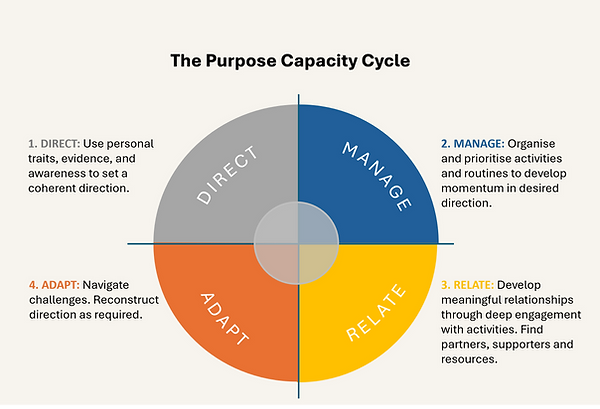
This is the psychologically mature pathway. The individual must do some of the cognitive work of constructing purpose. They aren't necessarily alone — quite the opposite. Relationships, communities, institutions and culture can all contribute but the organising direction remains internally endorsed. As the individual navigates their journey to purpose, they start to develop the psychological capacities that support and sustain purpose from the inside out. This starts with direction (Direct) – the ability to know enough about oneself to orient one’s life towards a coherent path. This does not need to be anything grand at the start, and is often quite simple for younger adults, but it is backed by reasoning, reflection and coherence. Second comes agency, the ability to move oneself towards the direction of travel (Manage). This self-management builds the capacity to act on the initial direction. Third comes the capacity to connect and relate (Relate). Building the relationships that give purpose social reality, community, support, and joy are essential. Lastly, the depth pathway supports resilience (Adapt) - the ability to maintain or reconstruct direction when circumstances change. No pathway to purpose is straightforward and without course correction. These four capacities form a genuinely compelling human purpose capacity system – capable of supporting purpose across all ages.
C. Scale: Build Purpose from the Outside
We are seeing another emerging response to current disruption. This is an attempt to create purpose through belonging, often at scale. This is the rise of people seeking purpose and meaning through movements, ideologies, tribes, mass identities, and collective narratives. These large movements - political, ideological, cultural – offer a ready-made identity, a sense of mission, a community, and a feeling of mattering. The problem is they can lead to ‘borrowed purpose’ rather than constructed purpose. Outsourcing direction and meaning to an external group can ultimately lead to extremity, rigidity, and lessen the sense of genuine purpose experienced. In our own research we even saw some signs that socially prescribed developmental milestones (think marriage, first job etc.,) showed weaker associations to meaning components (including purpose) than those that were more personally constructed.
What we see in the present day is that these phenomena (especially political tribalism) are acting as a purpose-vacuum. On the surface they seem to offer all the ingredients of purpose and meaning, but they compress (or remove) the cognitive work of purpose construction. If the group or collective is supplying what matters, norms, rules, discipline, belonging, certainty, and strength, then individuals are able to jump straight in at seemingly little cost.
The problem is not scale per se – scale is one of humanity’s greatest strengths – it is when collective purpose stops amplifying individual agency and starts replacing it that purpose weakens. The further purpose moves from authorship to adoption, the more vulnerable it may become to manipulation, polarisation, conformity and identity capture.
The question is not whether all three forms will continue to exist – they will. The question is how we assist people in building the psychological capacities to build purpose from within.
The Structural Response: Building a Purpose-Capable Society
This is not the part of the essay where I suddenly transform into an expert on education, health, work, technology, policy, community. That would be silly. It took me long enough to become an expert on purpose and meaning (and to a lesser extent the subbranch of psychology that specialises in motivation and emotion), to know I’m no expert on these things.
But we need to change how we think about purpose in each of these domains. We need to become more deliberate about the systems, services and infrastructure we design, so that they incorporate purpose as a strategic consideration rather than treating it as an afterthought. What I can offer are five principles for how we might begin that process.
A. Meet People Where They Are
Making purpose disruptive to people’s current way of life is not going to work. We need to understand where people currently are (age, stage, culture, location, habits, preferences) and work with that, not against it. Young people aren’t going to suddenly stop using their phones (a lot), regardless of regulation. We need to work with that. This could be new, creative apps that have purpose features built in, in ways that younger people can enjoy, relate to, and share. This could be through gaming. If the answer is ‘we’re going to do a purpose workshop in school’, then we’ve failed before we’ve even started. I’ve got nothing against these interventions – they can work (the research is there), but we shouldn’t be limited to this way of thinking.
Culturally, purpose is going to look very different for different groups. Indigenous peoples in Australia don’t need someone like me telling them how they should develop purpose. This is common sense – meet people where they are and where they want to go.
Every institution type (health, work, education, government) needs to embed this principle in the way they operate. This means thinking about age-related differences, culture-related differences etc., and even more granular segmentation. This is how smart strategy is performed – segment to the point of meaningful difference and then design from there.
B. Think Design Over Intervention
Helping people create purpose where they are at is a challenge of architecture and design. This requires system level thinking, which from my limited policy reading, is quite often missing, in favour of a shopping list of interventions and activities. We are not trying to redesign the individual (although in a lot of cases, thinking, activities, and habits will need to change), we are striving to change the environment in which people go about their lives. In some cases, this may seem seamless to the end user of a service, but in the background processes may have been radically redesigned with purpose as a central service element and outcome.
If you are anything like me (practical, sceptical) then you might be thinking…’sure, but if my visit to the GP is suddenly redesigned to incorporate purpose, I don’t suddenly have purpose in life’, then you are absolutely right. Here’s the mindset change that I think sits behind this principle. We can’t solve purpose in life for individuals. We can’t hand it to them or teach them it. It doesn’t work like that (in my mind). I think we are better off nudging systems in the direction of purpose supporting capacities. Maybe the redesign involves the GP asking one future-oriented question (“What are you working toward in your life right now that your health affects?”). Maybe a care plan template has been updated to include a ‘next step’ section. Nothing major, just nudging patients towards ‘manage’ and the psychological capacities that support purpose.
When these supports are embedded across health, education, work, and technology, people encounter small, cumulative nudges toward clarity, organisation, connection, and adaptation. Purpose becomes easier to build not because systems teach it, but because they stop making it harder.
C. Develop the Psychological Capacities for Purpose
This is not a new psychological approach – this is a well-trodden path, especially in motivation science circles. Self-determination theory argues for the environmental support of autonomy, relatedness, and competence, as conditions that promote intrinsic motivation and general well-being. Those workplaces that have engaged such services, already have experience creating supportive environments, and more importantly, eliminating need-thwarting environments.
Similarly, with purpose, the design goal is to help promote and develop the capacities to direct, manage, relate, and adapt. This also needs to respect the first principle: people differ in the psychological processes they already use to make sense of and direct their lives. Building on existing capacities is therefore likely to be more effective than trying to impose new ones.
Some opportunities to develop these capacities may also be completely or partially blocked for particular groups. Identifying and removing those blockages may therefore be one of the most effective places to start. Education for older adults is a good example. Opportunities exist, but they remain limited and are often designed around models created for younger people. Redesigning education around the four capacities could open entirely different pathways for later-life purpose.
D. Reduce Friction, Don’t Add Load
In designing purpose into systems, processes, services, and institutions, we need to be careful that we aren’t over complicating things. Technology has pushed convenience to a point where, without it, people will instantly disengage (unless sufficiently incentivised). So we need to make purpose easier across the lifespan, with simplicity especially important at either end of that scale (the youngest and the oldest). This is similar to principle one, but I see this more about ‘how’ than ‘where’.
For children, this maybe about simplifying choices and providing clear next steps as well as general education (capacities, purpose itself, beyond the self perspectives). For adolescents, this means reducing an already high level of overwhelm, as well as clarifying trajectories (what does purpose mean for the next five years). For middle-aged adults, stressed and time poor, designs will need to factor in lower cognitive load and integration with existing habits. For older adults it maybe about simplifying pathways, reducing commitments and complexity. Above all, this is about removing obstacles to purpose can emerge naturally.
E. Support Agency Without Demanding It
We cannot ‘do purpose’ for other people. They have to do it themselves. That is not a limitation of purpose interventions. It is a fundamental feature of purpose itself. This is the principle that avoids paternalism and works across cultures. We don’t want to undermine people’s ability to steer and navigate – this is a fundamental capacity and element of purpose in life. Cultural sensitivity applies here – those more collectivist in nature may require more relational scaffolds. More individualistic may shift the focus to choice architecture. Vulnerable groups may need to be supported with smaller, more manageable steps. Older adults may require more adaptive pathways. Education that is modular and time flexible (within reason) may be a great example of this for older adults.
The Future of Purpose
The forces described in this essay are not going away. We are living longer. Technology is expanding what we can do while destabilising some of the structures that once told us what to do. Young people are entering adulthood with unprecedented choice but increasing uncertainty about how to construct a future. And across all of this sits a basic psychological need: the need for our lives to have some direction.
I therefore suspect purpose is heading towards a transition.
For much of modern history, purpose could be treated as something that happened to people. Work provided structure. Families provided roles. Communities provided belonging. Institutions provided narratives about what a good life looked like. Individuals still had to make choices, of course, but much of the surrounding architecture did some of the work for them.
That architecture is changing.
The future may therefore require something quite different: people who are more capable of constructing purpose for themselves, and systems that are more capable of supporting them in doing so.
This does not mean everyone needs a grand mission. It does not mean turning every human life into a productivity project. And it certainly does not mean imposing one conception of what a purposeful life should look like.
It means recognising purpose for what it is: a psychological capacity with consequences far beyond psychology.
It affects how we organise our time, what we pay attention to, what we work towards, who we connect with, how we respond to setbacks and how we imagine our future. It can shape health, behaviour, identity, relationships and the way we experience ageing.
As the traditional sources of direction become less reliable, purpose may become less of a luxury and more of a form of psychological infrastructure.
The challenge is that infrastructure can be built well or badly.
We can build environments that help people develop direction, agency, connection and adaptability. Or we can leave the vacuum to be filled by whatever is most effective at capturing attention, supplying identity or creating belonging.
That may ultimately be the central psychological question of the next twenty years.
When the world stops telling us what our lives are for, will we become better at deciding for ourselves?
And if we can, will the systems around us help us do it?
References
1. Ryff, C. D. (1989). Happiness is everything, or is it? Explorations on the meaning of psychological well-being. Journal of Personality and Social Psychology, 57(6), 1069–1081. https://doi.org/10.1037/0022-3514.57.6.1069
2. McKnight, P. E., & Kashdan, T. B. (2009). Purpose in life as a system that creates and sustains health and well-being: An integrative, testable theory. Review of General Psychology, 13(3), 242–251. https://doi.org/10.1037/a0017152
3. Pfund, G. N., & Lewis, N. A. (2020). Aging with purpose: Developmental changes and benefits of purpose in life throughout the lifespan. In P. L. Hill & M. Allemand (Eds.), Personality and Healthy Aging in Adulthood (Vol. 26, pp. 27-42). Springer International Publishing. https://doi.org/10.1007/978-3-030-32053-9_3
4. Boreham, I. D., & Schutte, N. S. (2023). The relationship between purpose in life and depression and anxiety: A meta-analysis. Journal of Clinical Psychology, 79(12), 2736–2767. https://doi.org/10.1002/jclp.23576
5. Wood, A. M., & Joseph, S. (2010). The absence of positive psychological (eudaimonic) well-being as a risk factor for depression: A ten-year cohort study. Journal of Affective Disorders, 122(3), 213–217. https://doi.org/10.1016/j.jad.2009.06.032
6. Krentzman, A. R., Cranford, J. A., & Robinson, E. A. R. (2015). Long-term increases in purpose in life are associated with remission from alcohol dependence. Alcoholism Treatment Quarterly, 33(3), 252–269. https://doi.org/10.1080/07347324.2015.1050924
7. Martin, R. A., MacKinnon, S., Johnson, J., & Rohsenow, D. J. (2011). Purpose in life predicts treatment outcome among adult cocaine abusers in treatment. Journal of Substance Abuse Treatment, 40(2), 183–188. https://doi.org/10.1016/j.jsat.2010.10.002
8. Kim, E. S., Chen, Y., Nakamura, J. S., Ryff, C. D., & VanderWeele, T. J. (2022). Sense of purpose in life and subsequent physical, behavioral, and psychosocial health: An outcome-wide approach. American Journal of Health Promotion : AJHP, 36(1), 137–147. https://doi.org/10.1177/08901171211038545
9. Willroth, E., & Mroczek, D. (2021). Maintaining sense of purpose in midlife predicts better physical health. Innovation in Aging, 5(Suppl 1), 213. https://doi.org/10.1093/geroni/igab046.821
10. Zhang, Z., & Chen, W. (2021). Longitudinal associations between physical activity and purpose in life among older adults: A cross-lagged panel analysis. Journal of Aging and Health, 33(10), 941–952. https://doi.org/10.1177/08982643211019508
11. Bronk, K. C. (2011). The role of purpose in life in healthy identity formation: A grounded model. New Directions for Youth Development, 2011(132), 31–8. https://doi.org/10.1002/yd.426
12. Burrow, A. L., O’Dell, A. C., & Hill, P. L. (2010). Profiles of a developmental asset: Youth purpose as a context for hope and well-being. Journal of Youth and Adolescence, 39, 1265–1273. https ://doi.org/10.1007/s1096 4-009-9481-1
13. Joshanloo, M. (2024). Purpose in life links positive aging views to life satisfaction: A within-person analysis spanning 13 years. Journal of Applied Gerontology, 43(5), 471-480.
14. Lewis, N. A., Turiano, N. A., Payne, B. R., & Hill, P. L. (2017). Purpose in life and cognitive functioning in adulthood. Neuropsychology, Development, and Cognition. Section B, Aging, Neuropsychology and Cognition, 24(6), 662–671. https://doi.org/10.1080/13825585.2016.1251549
15. Boyle, P. A., Buchman, A. S., Barnes, L. L., & Bennett, D. A. (2010). Effect of a purpose in life on risk of incident Alzheimer disease and mild cognitive impairment in community-dwelling older persons. Archives of General Psychiatry, 67(3), 304–310. https://doi.org/10.1001/archgenpsychiatry.2009.208
16. Kim, E. S., Sun, J. K., Park, N., & Peterson, C. (2013). Purpose in life and reduced incidence of stroke in older adults: ‘The Health and Retirement Study’. Journal of Psychosomatic Research, 74(5), 427–432. https://doi.org/10.1016/j.jpsychores.2013.01.013
17. Turner, A.D., Smith, C.E. & Ong, J.C. (2017). Is purpose in life associated with less sleep disturbance in older adults? Sleep Science Practice, 1, 14 (2017). https://doi.org/10.1186/s41606-017-0015-6
18. Ariji, H., Ahmad, I., Shirayama, Y., Okamoto, M., Taimur, H., & Yuasa, M. (2025). Correlates of purpose in life and their potential role in successful aging among older adults in rural Japan. European Journal of Investigation in Health, Psychology and Education, 15(12), 250. https://doi.org/10.3390/ejihpe15120250
19. World Health Organization (2025, October 1). Ageing and health. https://www.who.int/news-room/fact-sheets/detail/ageing-and-health
20. Zhao, X., Liu, L., Zhang, L., Zhao, P., Jiang, W., & Nahata, M. C. (2026). The global burden of mental and substance use disorders among adolescents and young adults. Molecular Psychiatry, 31, 3880–3897. https://doi.org/10.1038/s41380-026-03503-9
21. Santomauro D, Miller P, Shadid J et al. (2026). Updated trends in the global prevalence and burden of mental disorders, 1990–2023: A systematic analysis for the Global Burden of Disease Study 2023. The Lancet, 407(10543), 2040-2064. https://www.thelancet.com/journals/lancet/article/PIIS0140-6736(26)00519-2/
22. Boreham, I. D., O’Gorman, C. & Bailey, P. E. (2025). Purpose in life and temporal focus across the adult lifespan. Ageing International, 50, article 58. https://doi.org/10.1007/s12126-025-09638-4